Zirconia Sintering Guide: Programs, Cooling and Common Mistakes
Zirconia sintering is where a soft, chalky milled restoration becomes a dense, strong and translucent crown. It is also where many lab problems start: cracks, cloudy shades, poor fit and gray discoloration often come from the furnace, not from the material. This guide explains what happens during sintering, how to choose the right program and how to avoid the most common mistakes.
What happens during sintering?
Pre-sintered zirconia is porous. During sintering the particles fuse together, the pores close and the restoration shrinks by roughly 20–25% in each direction. Your CAM software already compensates for this with the enlargement factor printed on the disc, which is why the right disc data and the right program matter so much. Only after full sintering does zirconia reach its final strength, translucency and shade.
The three stages of a sintering program
- Heating. The temperature rises at a controlled rate. Heating too fast creates temperature differences inside the restoration and can cause internal stress, especially in thick pontics.
- Holding at the peak temperature. Most dental zirconia sinters somewhere between 1,450 and 1,550 °C, with a hold time set by the manufacturer. For example, UPCERA ST White and ST Color sinter at 1,530 °C, while DUO, Explore and Aevra sinter at 1,480 °C.
- Cooling. A controlled cool-down is just as important as heating. Cooling too fast, or opening the furnace too early, can crack the area between a thick pontic and thin walls.
How to choose the right program
- Use the program for the exact material. One universal program for every zirconia is the most common cause of shade and strength problems.
- Do not mix materials in one cycle unless they share the same program.
- Use speed programs only when both the material and the furnace are approved for them. Large bridges and bulky restorations are safer with a conventional, slower program.
- Save programs in the furnace controller with clear names, for example “UPCERA DUO 1480”, so nobody has to type values by hand.
Preparing restorations for the furnace
- Clean off milling dust with a soft brush or oil-free air.
- Dry colored restorations completely. After using coloring liquids, dry the restoration as the liquid’s instructions say before sintering. Residual moisture is a classic cause of cracks and shade spots.
- Support restorations correctly. Place them on sintering beads or a tray so they do not touch each other or the walls, and support long bridges along their length to prevent sagging.
- Use a saggar with a lid to protect restorations from contamination and give even heat.
Common sintering problems and their causes
| Problem | Most likely causes |
|---|---|
| Cracks | Heating or cooling too fast, restorations still wet from coloring liquid, opening the furnace too early, very uneven wall thickness |
| Chalky, opaque or weak result | Peak temperature too low or hold time too short (under-sintering), wrong program for the material |
| Gray or greenish discoloration | Contaminated furnace chamber or heating elements, metal contact during handling, no saggar lid |
| Shade too dark or too light | Wrong program, coloring liquid too concentrated or not dried, wrong position in a multilayer disc |
| Poor fit or distortion | Wrong enlargement factor in CAM, poorly supported bridges, overloaded tray |
Keep your furnace in good condition
- Check the temperature calibration regularly, as described in the furnace manual.
- Keep the chamber clean and follow the manufacturer’s maintenance or regeneration firing for the heating elements.
- Use only original trays, saggars and accessories made for your furnace.
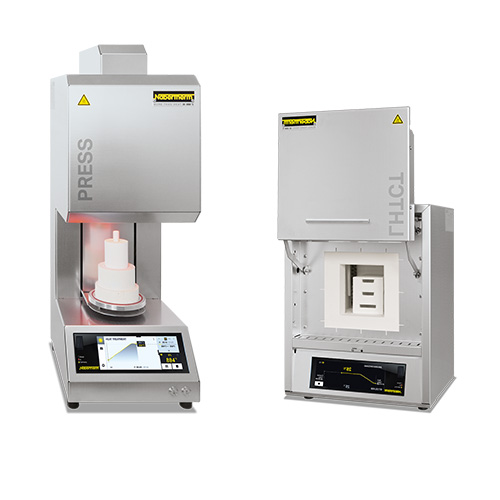
Nabertherm sintering equipment from Aqras Medical
As the official Nabertherm partner in Saudi Arabia, we supply the Nabertherm LHTCT 01/16 sintering furnace and the matching plate set charge saggar. The saggar has ventilation openings and a lid, measures 110 × 75 × 30 mm outside (95 × 60 × 20 mm inside), and fits the LHT 01/17, LHTCT 01/16, LHTCT 03/16 and LHT 01/17 D furnaces.
Need a furnace, accessories or advice on sintering programs? Add the items to your quote request or message us on WhatsApp, and we will reply with availability and a quotation.
Frequently asked questions
What temperature is zirconia sintered at?
Most dental zirconia sinters between 1,450 and 1,550 °C. The exact program depends on the material: UPCERA ST White and ST Color sinter at 1,530 °C, and DUO, Explore and Aevra at 1,480 °C.
Why did my zirconia crack in the furnace?
The most common causes are heating or cooling too fast, restorations that were not fully dry after coloring, opening the furnace too early and very uneven wall thickness, such as a thick pontic next to thin walls.
Why does my sintered zirconia look chalky or opaque?
A chalky look usually means under-sintering: the peak temperature was too low, the hold time too short, or the program did not match the material. Check the program and the furnace calibration.
Can I sinter different zirconia brands together?
Only if they use the same sintering program. Otherwise at least one material will be sintered at the wrong temperature, which affects strength, shade and translucency.
Is speed sintering safe for zirconia?
Only when both the zirconia and the furnace are approved for the speed program. For long-span bridges and bulky restorations, a conventional program is the safer choice.