3Y vs 4Y vs 5Y Zirconia: Which One for Each Restoration?
Choosing between 3Y vs 4Y vs 5Y zirconia is one of the first decisions a dental laboratory makes on every case. The number tells you how much yttria the zirconia contains, and that single figure decides how strong the restoration will be, how translucent it will look and which indications it can safely handle. This guide explains the differences in plain terms and gives you a practical way to pick the right disc for crowns, bridges and veneers.
3Y, 4Y and 5Y zirconia at a glance
| Type | Yttria content | Typical strength | Translucency | Best suited for |
|---|---|---|---|---|
| 3Y-TZP | about 3 mol% | highest (often 1,000–1,300 MPa) | lowest | Posterior crowns, long-span and implant bridges, bruxism cases |
| 4Y-PSZ | about 4 mol% | medium | medium | Premolars, anterior crowns, short bridges |
| 5Y-PSZ | about 5 mol% | lowest (often 600–800 MPa) | highest | Anterior single crowns, veneers, high-esthetic cases |
What does the “Y” in 3Y, 4Y and 5Y mean?
Dental zirconia is zirconium oxide stabilized with yttrium oxide (yttria). The number in front of the “Y” is the yttria content in mol%. More yttria changes the crystal structure of the material:
- 3Y-TZP is almost fully tetragonal. When a crack starts, the crystals around it transform and expand, squeezing the crack closed. This “transformation toughening” is why 3Y is so strong.
- 4Y and 5Y contain a growing share of cubic crystals. Cubic grains are larger and scatter less light, so the material becomes more translucent, but they do not transform under stress, so strength and fracture toughness drop.
In short: more yttria means more translucency and less strength. Every zirconia choice is a balance between the two.
3Y-TZP: maximum strength
3Y-TZP is the classic high-strength zirconia. It tolerates thinner walls and smaller connectors than the more translucent grades, which makes it the safe choice when the restoration has to carry heavy loads.
- Posterior monolithic crowns, especially for patients who grind or clench
- Long-span and multi-unit bridges
- Implant-supported restorations and full-arch frameworks
- Cores and copings that will be layered with porcelain
- Masking dark or discolored preparations
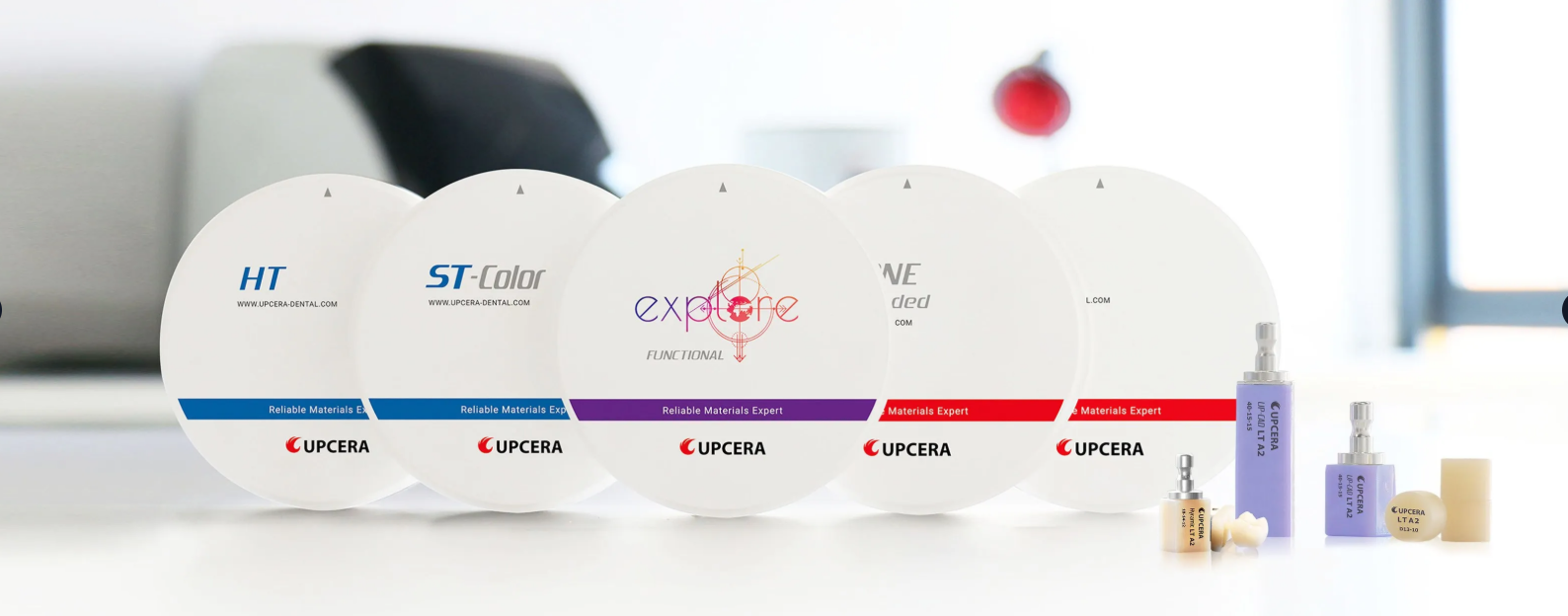
UPCERA ST White and ST Color are 3Y-TZP discs with a stated strength of 1,300 MPa and 43% translucency. ST White is unshaded for coloring liquids or layering, while ST Color comes pre-shaded in the 16 VITA classical shades. A useful tip for ST Color: applying a T0 coloring liquid to the incisal area before sintering softens the pre-shaded base and gives a more natural incisal translucency.
4Y-PSZ: the balanced middle ground
4Y zirconia sits between the two extremes. It is noticeably more translucent than 3Y, yet keeps enough strength for most single crowns and short bridges. Labs often use it for premolars and anterior crowns where the patient expects a natural look but the bite is still demanding.
Because the strength is lower than 3Y, follow the manufacturer’s minimum wall thickness and connector size closely, particularly for bridges in the posterior region.
5Y-PSZ: maximum esthetics
5Y zirconia is the most translucent grade and comes closest to lithium disilicate in appearance. It is ideal for anterior single crowns, veneers and cases where the restoration sits next to natural teeth with high translucency.
Its weak point is strength and fracture toughness. Studies on multi-unit bridges consistently show that 3Y and 4Y perform better than 5Y in the molar region, so 5Y should not be the first choice for posterior bridges or patients with parafunction.
Multilayer zirconia: combining the grades in one disc
Modern multilayer discs combine different yttria levels in a single puck: a stronger, more chromatic cervical body and a more translucent incisal layer. This lets one restoration be strong where it carries load and translucent where it needs to look natural.
- UPCERA DUO combines 3Y and 5Y powders for a universal disc that covers anterior crowns up to full-arch bridges (850–1,200 MPa, 45–48% translucency).
- UPCERA Explore comes in two versions: Functional (3Y to 4Y, 1,027–1,300 MPa) for strength-critical cases and Esthetic (727–1,000 MPa, up to 48.8% translucency) for esthetic zones.
- UPCERA Aevra is a 4Y–5Y esthetic gradient disc with translucency from 46% at the cervical to 50% at the incisal edge.
When you mill a multilayer disc, the position of the restoration inside the disc decides how much of each layer it receives, so nest crowns carefully in your CAM software.
How to choose the right zirconia for each case
Ask these questions before you pick a disc:
- Where is the restoration? Posterior and load-bearing cases lean toward 3Y or a strong multilayer. Anterior cases can move toward 4Y, 5Y or an esthetic gradient.
- How many units? The longer the span, the more strength you need in the connectors. Single units leave more freedom.
- How much space is there? Thin walls and small connectors need a stronger grade.
- What is underneath? A dark stump or metal post needs a more opaque material; very translucent zirconia will let the color show through.
- Does the patient grind? Bruxism is a strong reason to choose 3Y.
- How high are the esthetic expectations? High-end anterior work benefits from 5Y or a multilayer with a translucent incisal layer.
Common mistakes to avoid
- Using highly translucent zirconia for posterior bridges. It may look better on the screen, but connectors are where bridges fail.
- Ignoring the sintering program. Each disc has its own temperature: UPCERA ST White and ST Color sinter at 1,530 °C, while DUO, Explore and Aevra use 1,480 °C. The wrong program changes strength, shade and translucency.
- Sintering different materials together. Mixing discs with different programs in one cycle means at least one of them is sintered incorrectly.
- Cutting below the minimum thickness. Follow the manufacturer’s minimum wall and connector dimensions for the grade you use.
UPCERA zirconia discs available at Aqras Medical
| Disc | Type | Strength | Translucency | Typical use |
|---|---|---|---|---|
| ST White | 3Y-TZP, unshaded | 1,300 MPa | 43% | Cores, copings, high-strength monolithic work |
| ST Color | 3Y-TZP, pre-shaded | 1,300 MPa | 43% | Posterior crowns, long-span bridges |
| DUO | 3Y + 5Y multilayer | 850–1,200 MPa | 45–48% | Universal: anterior to full-arch |
| Explore | Multilayer (Functional / Esthetic) | 727–1,300 MPa | 43–48.8% | Strength-critical or esthetic cases |
| Aevra | 4Y–5Y gradient | see data sheet | 46–50% | High-esthetic anterior work |
All discs are available in VITA shades and multiple thicknesses. As the official UPCERA partner in Saudi Arabia, we can help you choose the right disc and sintering program for your cases. Add the discs you need to your quote request, or send us the case details on WhatsApp.
Frequently asked questions
Is 3Y zirconia stronger than 5Y zirconia?
Yes. 3Y-TZP has the highest strength and fracture toughness because its tetragonal crystals can transform and stop cracks. 5Y-PSZ trades part of that strength for higher translucency.
Can 5Y zirconia be used for bridges?
5Y zirconia is best kept for anterior single crowns and veneers. For posterior or multi-unit bridges, 3Y, 4Y or a strong multilayer disc is the safer choice because bridges usually fail at the connectors.
What is the difference between ST and multilayer zirconia?
ST zirconia has one uniform composition through the whole disc. Multilayer zirconia combines layers with different yttria levels, so the cervical part is stronger and more chromatic and the incisal part more translucent.
Which zirconia is best for patients who grind their teeth?
High-strength 3Y-TZP, such as UPCERA ST White or ST Color, is the usual choice for bruxism cases because it has the highest fracture resistance.
Do 3Y, 4Y and 5Y zirconia use the same sintering program?
Not always. Each disc has its own recommended program. For example, UPCERA ST White and ST Color sinter at 1,530 °C, while DUO, Explore and Aevra use 1,480 °C. Always follow the manufacturer’s instructions.